
Artificial intelligence has changed the way students learn, research, write, and prepare for exams. In 2026, students no longer need to spend hours searching through dozens of websites or struggling with difficult topics on their own. The right AI tool can help explain complex subjects, organize study materials, improve writing, create presentations, solve mathematical problems, and even assist with coding.
But there is one problem: there are now thousands of AI tools available, and not all of them are worth using.
Some tools are excellent for research but not very useful for studying. Others are great for writing but have limitations in their free plans. Some are designed specifically for students, while others are general-purpose AI assistants that can be used for education.
That is why we created this guide to the 10 best free AI tools for students in 2026.
In this article, we’ll look at tools that can help students with everyday academic tasks, including studying, research, writing, mathematics, presentations, exam preparation, and programming.
We’ll also explain what each tool is best for,who should use it, and what students should know before choosing it.
Important: “Free”does not always mean unlimited.Many AI platforms offer free access with usage limits or certain features restricted to paid plans. Always check the current free-plan conditions before relying on a tool for important academic work.
10 Best Free AI Tools for Students in 2026
What Are AI Tools for Students?
For students, AI tools can be incredibly useful for understanding difficult concepts and making learning more efficient. Here are some of the ways students can use AI in their studies:
- Understand difficult concepts:If you don’t understand a topic from your textbook or class,you can ask an AI tool to explain it in simple language,step by step.
- Summarize study materials:You can use AI to summarize lengthy notes, articles, PDFs, or textbook content so you can review the key points more quickly.
- Research a topic: If you need to research a particular subject but don’t know where to start, you can ask an AI tool for help. It can organize information and help you understand a topic more clearly.
- Improve grammar and writing: AI tools can help identify grammar mistakes and improve the clarity, structure, and overall quality of your writing.
- Create study notes: If you have a large amount of information to organize, AI can help turn it into clear and structured study notes.
- Generate important questions: You can ask AI to create a list of important questions from a particular chapter or topic to help you prepare for exams.
- Create flashcards: AI can help you turn important facts, terms, and concepts into flashcards for easier memorization and revision.
- Solve math problems: If you’re struggling with a mathematical problem and cannot get help from a teacher or classmate, you can use AI to work through the problem and explain the solution step by step.
- Prepare presentations: If you need to give a presentation but don’t know how to structure it, you can ask AI to create a presentation outline or draft based on your topic. You can then customize it in your own words.
- Learn programming: Students learning programming can use AI to understand programming concepts, explain code, find errors, and practice writing code.
- Brainstorm new ideas: AI can help you explore new ideas, develop creative concepts, and learn about unfamiliar subjects.
- Organize information: If you have information from multiple textbooks, notes, or study materials that you want to organize in one place, AI can help structure and summarize that information.
The key is to use AI as a study assistant, not as a replacement for your own learning. Always review important information and make sure you understand the material yourself.
Quick Comparison Table
| # | Tool | Best For | Key Strength | Free Tier? | Notes / Typical Pricing |
|---|---|---|---|---|---|
| 1 | ChatGPT | All-around help, brainstorming, explanations, coding | Most versatile general assistant | Yes (limits on advanced models) | Paid from ~$8–20/mo; Study Mode available |
| 2 | NotebookLM | Studying your own notes, PDFs, lectures | Answers grounded only in your uploaded sources + citations + audio overviews | Yes (generous) | Excellent for exam prep from class materials; Plus upgrades available |
| 3 | Perplexity AI | Research with real citations | Live web search + clickable sources for every claim | Yes (limited Pro features) | Strong for papers; Education Pro often discounted for students |
| 4 | Google Gemini | Google ecosystem users, general queries, multimodal | Deep integration with Docs, Drive, Gmail + strong free tier | Yes (very generous) | Great if you already live in Google tools |
| 5 | Grammarly | Writing polish, grammar, clarity, tone | Real-time suggestions across browsers & apps | Yes | Pro ~$12/mo (annual); widely used for final essay checks |
| 6 | QuillBot | Paraphrasing, summarizing, rewriting | Clean rephrasing + citation tools | Yes (word limits) | Good student rates; useful for avoiding repetition |
| 7 | Photomath | Math problem solving (photo input) | Step-by-step solutions from handwritten or printed problems | Yes (basic steps) | Plus for more advanced explanations |
| 8 | Notion AI | Note-taking, organization, task management | AI inside your existing notes & databases | Limited / trial | Often free or discounted for students via Notion Plus |
| 9 | Quizlet AI | Flashcards & active recall | AI-generated sets, Q-Chat tutor, Magic Notes | Yes | Plus for unlimited AI features |
| 10 | Gamma AI | Presentations & visual decks | Turns a prompt/outline into a designed slide deck or webpage in seconds | Yes (credits) | Fastest path to polished presentations; Plus ~$9/mo |
Note: Pricing is based on the tool’s official website and may change over time. Please check the official website for the latest pricing. Prices shown here are for reference only and are not fixed.
How We Choose the Best AI Tools for Students
When selecting AI tools for students, we focus on one important question: Which tool can a student actually use easily and effectively?
Not every AI tool is suitable for every student or every academic task. Some tools are better for research, while others are more useful for writing, mathematics, presentations, coding, or exam preparation. That’s why we carefully consider the specific needs of students before including a tool in our recommendations.
Another important factor is the free plan. Students often have limited budgets, so we focus on tools that provide useful features through their free plans. We believe students should be able to get meaningful value without immediately having to pay for a premium subscription.
What Do We Consider When Testing AI Tools?
We don’t judge an AI tool simply by how popular it is. We look at several important factors, including:
- Ease of use — Can a student use the tool without a complicated learning curve?
- Response quality — Does it provide clear and useful answers?
- Accuracy — How reliable is the information it provides?
- Research capabilities — Can it help students research a topic effectively?
- Writing ability — Can it help improve writing, grammar, and organization?
- Student usefulness — Does the tool actually solve common problems students face?
- Free-plan value — What can students realistically do without paying?
- Overall performance — Does the tool perform well for the tasks it claims to support?
Research capability is especially important. Simply providing a lot of information doesn’t necessarily mean an AI tool is good at research. Students need information that is relevant, understandable, and as accurate as possible, and important claims should still be verified using reliable sources.
Not Every AI Tool Is for Everyone
One thing we want to make clear is that no single AI tool is perfect for every student or every situation.
A tool that works extremely well for programming may not be the best choice for writing an essay. Similarly, a research-focused tool may not be the best option for creating flashcards or solving mathematics problems.
That’s why, throughout this guide, we’re focusing specifically on how useful each tool can be for students and what type of academic task it is best suited for.
Our Commitment to Accuracy
We make every effort to provide accurate and useful information in this guide. However, AI tools frequently change their features, pricing, free-plan limits, and capabilities. Information that is accurate today may change in the future.
We are also human, and mistakes can happen. While we do our best to check the information and present it responsibly, we cannot guarantee that every detail will always be completely error-free.
If you notice an error or outdated information, we appreciate your understanding and encourage you to verify important information directly with the relevant tool or its official website.
Our goal is simple: to help students find useful AI tools, understand what each tool is good at, and make a better decision about which one is right for them.
Top 10 Free AI Tools for Students in 2026
Here are the 10 tools we’ll cover in this guide:
| # | AI Tool | Best For |
|---|---|---|
| 1 | ChatGPT | Studying, explanations & brainstorming |
| 2 | NotebookLM | Studying PDFs, notes & course materials |
| 3 | Perplexity AI | Research with citations |
| 4 | Google Gemini | Research, writing & study help |
| 5 | Grammarly | Grammar & writing improvement |
| 6 | QuillBot | Paraphrasing & summarizing text |
| 7 | Photomath | Math & step-by-step problem solving |
| 8 | Notion AI | Organizing notes & study plans |
| 9 | Quizlet AI | Flashcards & exam preparation |
| 10 | Gamma AI | Presentations & student projects |
10 Best Free Al Tools for Students in 2026
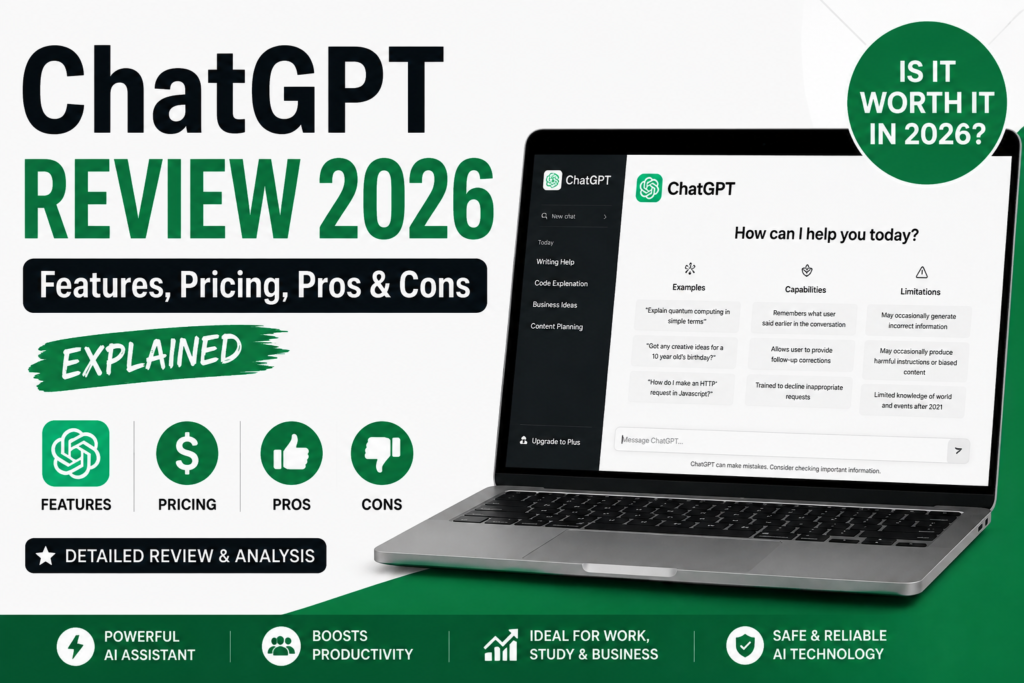
ChatGPT is a versatile AI study assistant for students, which can be used for various study tasks. It is useful for understanding difficult topics in simple language, creating study notes and summaries of any topic, creating important questions and practice questions, and getting ideas about a new topic. Students can also use ChatGPT for writing improvement, grammar checking, brainstorming, presentation preparation, and step-by-step problem solving. In addition, if you have difficulty understanding a topic, you can ask questions in your own language and get simple explanations, which can be helpful in learning and exam preparation.
Pros & Cons
Pros: Extremely versatile, easy to use, huge knowledge base Cons: Can occasionally get facts wrong, so always double-check important details.
NotebookLM is a useful AI study tool for students who want to learn from their own PDFs, lecture notes, study materials, and course documents. It can help summarize lengthy materials, explain difficult topics in simpler language, find important information, and generate useful questions from your study content. Students can also use NotebookLM to organize their learning materials and quickly review key information while preparing for exams.
Pros & Cons
Pros: Won’t hallucinate information about your specific course material; great for exam prep from a set reading list Cons: Not useful for general questions outside what you’ve uploaded.
Perplexity AI is a useful AI research tool for students who need to find and understand information quickly. It can help students research a topic, answer questions, summarize information, and find relevant sources and citations for further reading. When working on assignments or research projects, students can use Perplexity AI to explore a subject, compare information, and get a clearer understanding of unfamiliar topics.
Pros & Cons
Pros: Citations make it easy to verify claims and build a bibliography Cons: Less useful for creative writing or open-ended brainstorming than ChatGPT.
Google Gemini is a versatile AI tool that students can use for research, studying, writing, and brainstorming. It can help explain difficult concepts in simple language, summarize study materials, generate ideas, and assist with assignments and projects. Students can also use Gemini to create study notes, practice questions, and presentation ideas, making it a useful AI study assistant for everyday learning and exam preparation.
Pros & Cons
Pros: Seamless if you already write in Google Docs Cons: Best features may require a school or paid account.
Grammarly is a useful AI writing tool for students who want to improve their grammar, spelling, clarity, and overall writing quality. It can help check essays, assignments, emails, and other academic writing for common mistakes and suggest clearer ways to express ideas. Students can also use Grammarly to make their writing more polished, professional, and easier to understand before submitting their work.
Pros & Cons
Pros: Works everywhere you write, minimal learning curve Cons: Free plan holds back some of the more advanced rewriting suggestions.
QuillBot is an AI writing tool that can help students with paraphrasing, summarizing, and improving written content. It can rewrite sentences in different ways while keeping the original meaning, making it useful when students want to improve the clarity and flow of their writing. QuillBot can also help summarize longer text and make study materials easier to review and understand.
Pros & Cons
Pros: Fast way to rephrase or condense text Cons: Word limits on the free plan can feel restrictive for longer documents.
Photomath is an AI-powered math tool that helps students solve mathematical problems and understand the steps behind the solution. Students can use it for topics such as arithmetic, algebra, geometry, trigonometry, and calculus. Instead of only providing an answer, Photomath can show step-by-step explanations, making it useful for learning, checking homework, and practicing math problems.
Pros & Cons
Pros: Actually teaches the method, not just the answer Cons: Advanced or oddly formatted problems can sometimes trip up the scanner.
Notion AI is a useful productivity and study tool for students who want to organize notes, manage tasks, and plan their studies in one place. It can help summarize notes, organize information, generate ideas, improve written content, and create structured study plans. Students can also use Notion AI to keep class notes and study materials organized, making it easier to manage assignments and prepare for exams.
Pros & Cons
Pros: Great for staying organized across multiple classes Cons: AI credits run out quickly on heavy use
Quizlet AI can help students turn their study materials into flashcards, practice questions, and study activities. It is useful for reviewing important terms, concepts, and facts before exams. Students can use it to make revision more interactive, test their knowledge, and focus on areas where they need more practice.
Pros & Cons
Pros: Makes exam revision faster and more structured Cons: Some advanced study modes are locked behind a paid plan.
Gamma AI is a useful AI presentation tool for students who need to create presentations, slide decks, and visual study materials quickly. Students can enter a topic or idea, and Gamma can help organize the information into a structured presentation. It can also help improve the layout and presentation of content, making it useful for class projects, assignments, and academic presentations.
Pros & Cons
Pros: Saves significant time on slide design Cons: Free credits are limited, so plan bigger projects carefully.
Using AI Responsibly as a Student
AI tools are most valuable when they support your learning rather than replace it. A few ground rules worth keeping in mind:
- Check your school’s AI policy. Rules vary widely by institution and even by professor.
- Use AI to understand, not just to finish. Tools like NotebookLM and Photomath are most useful when you follow the explanation, not just copy the output.
- Always verify facts and citations, especially from general-purpose chat tools, before including them in academic work.
- Don’t submit AI-generated text as your own writing unless your instructor explicitly allows it — this can violate academic integrity policies.
FAQ
Are these AI tools really free? Yes — all ten offer a genuinely usable free tier. Some have daily usage limits or reduced features compared to their paid plans, but none require payment to get real value.
Which AI tool is best for essay writing? ChatGPT is the most versatile for brainstorming and drafting, while Grammarly is best for polishing and proofreading the final draft.
Can professors detect AI-generated work? AI-detection tools exist but are not fully reliable. The safer approach is to follow your school’s academic integrity policy and use AI to support your own writing rather than replace it.
Which tool is best for research with sources? Perplexity AI is built specifically for this — it provides cited, verifiable sources alongside its answers.
Which tool is best for studying from my own textbook or notes? NotebookLM, since it only answers based on documents you upload, making it far less likely to introduce outside or incorrect information.
How We Tested and Reviewed These AI Tools
We evaluated these AI tools based on how useful and easy they are for students in everyday learning. Our review focused on ease of use, response quality, accuracy, research capabilities, writing assistance, study features, and free-tier value.
We considered the types of tasks students commonly need help with, including understanding difficult concepts, summarizing study materials, researching topics, improving writing, creating study notes, preparing questions, solving math problems, making presentations, and learning programming.
Our goal is not to say that one AI tool is perfect for everyone. Instead, we look at what each tool does well, where it can be useful for students, and which type of student or academic task it is best suited for.
AI tools can change their features, limits, and pricing over time, so some details may change after publication. We make every effort to keep the information accurate and useful, but readers should verify important information with the tool’s official website.

Thanks