ChatGPT vs Claude for Content Writing
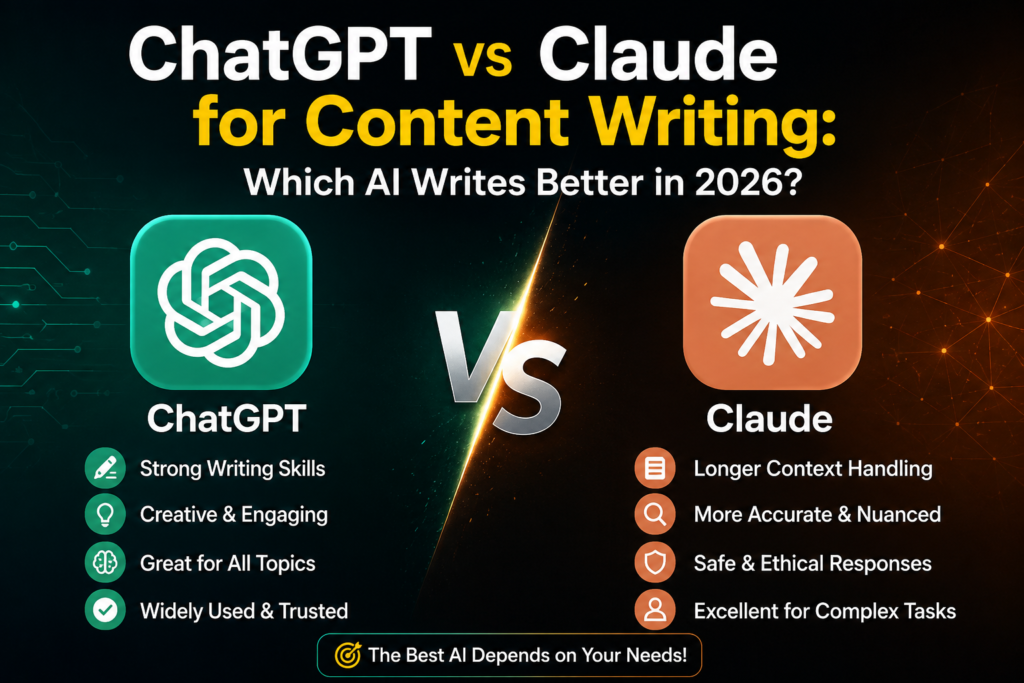
If you write blog posts, product descriptions, emails, or social captions for a living (or a side hustle), you’ve probably asked yourself the same question we get asked constantly: should you be using ChatGPT or Claude for content writing?
We tested both tools side by side on the same writing tasks — blog intros, long-form articles, SEO content, editing, and tone control — to see which one actually holds up for real content work in 2026, not just in a quick demo.
Here’s what we found.
Quick Answer
- Choose ChatGPT if you want speed, strong SEO/keyword-focused drafts, and a huge plugin/GPT ecosystem for research and formatting.
- Choose Claude if you want writing that sounds more human, holds a consistent voice across long documents, and needs less editing before publishing.
If you want the full breakdown of either tool on its own, check out our ChatGPT Review 2026 and Claude Review 2026.
ChatGPT vs Claude: At a Glance
ChatGPT vs Claude: At a Glance
| Feature | ChatGPT | Claude |
|---|---|---|
| Writing tone/voice | Good, sometimes generic | More natural, human-sounding |
| Long-form consistency | Can drift after ~1,500 words | Holds structure and voice well |
| SEO/keyword content | Strong, especially with plugins | Good, but less “SEO-native” |
| Editing existing drafts | Solid | Excellent — strong at matching your style |
| Speed | Fast | Slightly slower on long outputs |
| Free plan usability | Generous | More limited on free tier |
| Best for | Marketers, SEO writers, teams needing speed | Bloggers, freelancers, long-form and editorial work |
Writing Quality: Which One Actually Sounds Better?
This is the part most comparisons skip — they list features instead of judging actual writing.
When we gave both tools the same prompt (“write a 300-word blog intro about budget travel in Southeast Asia”), ChatGPT produced a competent, keyword-friendly intro that read a little like a template. Claude’s version had more natural sentence variation and fewer of the stock phrases (“in today’s fast-paced world,” “when it comes to”) that tend to flag AI writing to readers and to AI-detection tools.
For short-form copy (captions, product blurbs, ad copy), the gap narrows — both are genuinely good. The difference shows up most in long-form content, where Claude tends to keep a consistent voice from paragraph one to paragraph twenty, while ChatGPT can start to repeat structures or lose the original tone the longer the piece gets.
SEO Content and Keyword Writing
If your main use case is SEO blog posts, ChatGPT has an edge here — it’s more willing to naturally work in target keywords, suggest headers, and structure content the way search engines like to see it (especially with tools or plugins layered on top).
Claude can absolutely write SEO content too, but it’s less “aggressive” about keyword placement by default — you may need to explicitly ask it to include your target keywords a certain number of times, or in specific headers.
Our take: if you’re producing high-volume SEO content and speed/structure matters more than flawless prose, ChatGPT is the more efficient tool. If a handful of well-written, higher-quality articles matter more to you than volume, Claude is worth the switch.
Absolutely. I can help with SEO content and keyword writing, including:
- 🔍 Keyword research & keyword clustering
- 📄 SEO-optimized blog posts/articles
- 🎯 Primary, secondary & semantic keywords
- 🏷️ SEO titles, meta descriptions & H1–H3 headings
- 📃 Landing/product/service page content
- 🔗 Internal linking & anchor-text suggestions
- 📝 Search-intent-based content briefs
- 🌐 Local SEO content
- ✍️ Human-friendly, conversion-focused copy
- ♻️ Updating existing content for better rankings
- 📊 Keyword-to-page mapping and content plans
Happy to help with SEO content and keyword writing. To point this in the right direction, tell me a bit about what you need:
- Topic/niche or website — what’s the site or business about?
- Deliverable — are you looking for a blog post/article, product descriptions, landing page copy, a keyword list/strategy, or something else?
- Target keyword(s) — do you already have specific keywords in mind, or do you need help finding them?
If you give me even one of these (a topic is enough to start), I can draft content, suggest keyword clusters, or put together an SEO-optimized piece right away.
Editing and Rewriting Existing Content
This is where Claude stands out. Feed it an existing draft and ask it to “make this sound more like me” or “tighten this without changing the meaning,” and it tends to preserve your voice rather than overwriting it with its own default style. ChatGPT can do this too, but it more often nudges the text toward its own patterns unless you give it very specific instructions.
If your workflow is “write a rough draft, then get AI to polish it,” Claude is the stronger editor.
Tone Control and Brand Voice
Both tools can be given a style guide or example text to match a brand voice. In our testing, Claude was more consistent at sticking to a specified tone across multiple follow-up prompts in the same conversation — useful if you’re writing a whole series of blog posts or product pages that need to sound like the same person wrote them.
ChatGPT can match tone well in a single response but sometimes drifts back toward its default voice after a few back-and-forth edits.
Pricing for Content Writers
Both companies offer free tiers with usage limits, plus paid plans (roughly $20/month range at the Plus/Pro tier) for higher usage limits and access to their most capable models. Neither is meaningfully cheaper than the other for a solo writer — the real cost difference comes from how much editing time you save, which is where Claude’s stronger draft quality can offset a similar subscription price.
For exact current pricing, see our full ChatGPT Review 2026 and Claude Review 2026 — pricing changes often enough that we keep those pages updated rather than repeating numbers here that can go stale.
Chatgpt Pricing vs Claude Pricing
Pros and Cons
- Excellent for brainstorming
- Highly versatile
- Great for structured content
- Useful for SEO workflows
- Generates multiple content ideas
- Good for creative writing
- Can support multiple content-related tasks
- Some outputs may sound generic
- AI-generated content may require editing
- Can occasionally repeat information
- Facts should always be verified
- Natural writing style
- Excellent for long-form content
- Strong editing capabilities
- Good paragraph flow
- Useful for maintaining a consistent tone
- Helpful for rewriting content
- AI-generated content still requires fact-checking
- Results depend heavily on prompt quality
- Usage limits and features can vary by plan
Who Should Use ChatGPT for Content Writing?
- SEO bloggers who need keyword-structured drafts quickly
- Marketing teams producing high volumes of short-form content
- Writers who want a large ecosystem of plugins/GPTs for research, images, and formatting in one tool
Who Should Use Claude for Content Writing?
- Freelance writers and bloggers who want less editing after the AI draft
- Anyone writing long-form articles, essays, or newsletters where consistent voice matters
- Writers polishing or rewriting their own drafts rather than starting from a blank page
Final Verdict
Neither tool is objectively “better” at writing — they’re better at different parts of the writing process. ChatGPT is the faster, more SEO-friendly option for high-volume content. Claude is the more careful writer, better suited to long-form work and editing where voice and consistency matter more than raw speed.
Our honest recommendation: if you can, try both on your own writing samples before committing to a paid plan. What reads as “better” often comes down to your specific niche and how much editing time you’re willing to put in.
FAQ
Is Claude better than ChatGPT for blog writing? For long-form blog posts where tone and consistency matter, many writers find Claude’s output needs less editing. For fast, keyword-heavy SEO posts, ChatGPT is often quicker to work with.
Can I use ChatGPT and Claude together? Yes — a common workflow is drafting with one tool and editing/polishing with the other, since their strengths are different.
Does Claude sound more human than ChatGPT? In our side-by-side tests, Claude’s output used fewer common AI writing clichés and read more naturally, especially in longer pieces. Results can vary depending on your prompt and the specific model version.