


Claude Fable 5.2 Review
Anthropic released Claude Fable 5.2 on November 9, 2026, and it’s the most capable Claude model the general public can use. It comes with lower prices, faster output, and a big jump in coding and agentic work over Fable 5.1.
But “most powerful” doesn’t automatically mean “best for you.” In this review, we break down what’s new, what it costs, how it compares to rivals, and who should (and shouldn’t) pay for it.
Quick Verdict
Fable 5.2 is an excellent choice for long, complex, multi-step technical work: large coding projects, research, data-heavy analysis, and agent workflows. For everyday chat, writing, and routine coding, Anthropic itself recommends starting with Claude Opus 5.5 and moving up to Fable only when a task needs it.
Our rating: 4.5/5 (adjust after your own testing)
| Best for | Developers, researchers, analysts, teams running AI agents |
| Not ideal for | Casual chat, simple writing, security research |
| API price | $8 / $40 per million tokens (input / output) |
| Released | November 9, 2026 |
Pros
- Top-tier coding, reasoning, and agentic performance
- Faster and about 20% cheaper than Fable 5.1
- Strong efficiency at lower effort settings
- Fewer false-positive blocks than before
- More honest about uncertainty on long tasks
- Available across major cloud platforms
Cons
- Overkill for everyday tasks
- Still expensive compared with Sonnet and Haiku models
- Cybersecurity and biology tasks are blocked or rerouted
- Data retention required by default
- Many headline results come from Anthropic’s own testing
- Rivals still win some benchmarks
What Is Claude Fable 5.2?
Claude Fable 5.2 is part of Anthropic’s top “Mythos” tier of models. It shares the same underlying model as Claude Mythos 5.2. The difference is safeguards: Fable has strong cybersecurity and biology protections, which is why Anthropic can offer it to everyone. Mythos 5.2 is limited to verified organizations in cybersecurity and biomedical research.
In simple terms:
- Fable 5.2 is the public version.
- Mythos 5.2 is the restricted version for vetted security and life-science teams.
- Both sit above Claude Opus 5.5, Sonnet 5.5, and Haiku 5.5 in capability.
What’s New in Fable 5.2
1. Faster output at a lower price
Anthropic says Fable 5.2 generates output up to 30% faster than Fable 5.1, and API prices dropped about 20% compared with the previous version. There’s also an optional fast mode that speeds up generation by up to 2.5x, at double the price.
2. Better coding and long-running agent work
This is the headline upgrade. Anthropic reports that its engineers used the model to complete large software migrations, including moving a production service from Python to Rust. In one experiment, a Fable 5.2-led team of more than 1,000 subagents built a working prototype operating system over eight days. Treat these as vendor-reported examples, not guarantees for your own projects.
Early testers from companies like Vercel, Shopify, and Datadog described it as good at taking loose, ambiguous requests and finishing them with little back-and-forth.
3. Better efficiency at lower effort levels
At the default Medium effort in Claude apps and Claude Code, Fable 5.2 can handle hard tasks using fewer tokens than Fable 5.1. On Anthropic’s coding benchmark, High effort matched Opus 5.5’s best score at roughly half the cost per task.
4. Improved vision and chart reading
Chart-recognition accuracy rose sharply compared with Fable 5.1 (more in the benchmark table below).
5. Fewer unnecessary blocks
Fable’s safety classifiers sometimes blocked legitimate requests in earlier versions. Anthropic says Fable 5.2 shows about 55% fewer blocks than Fable 5.1 in early testing, while keeping safeguards as strong.
6. Honesty about what it doesn’t know
Anthropic’s safety testing found that the model hallucinated and falsely claimed task completion less often than recent models. That matters for long unattended jobs.

“Above, I am sharing a screenshot with you all. Here it is clearly stated, the date is given, the year is given. In the screenshot, it shows as available, so you can understand when it was published.”
Claude AI Model Selector Review
Choosing the right AI model can make a noticeable difference in how you work, especially when you use AI for writing, research, coding, or everyday problem-solving. Claude makes this choice relatively straightforward by bringing several models together in one model selection menu. Instead of forcing everyone to use a single model for every task, the interface gives users different options depending on their needs, available subscription, and preferred level of performance.
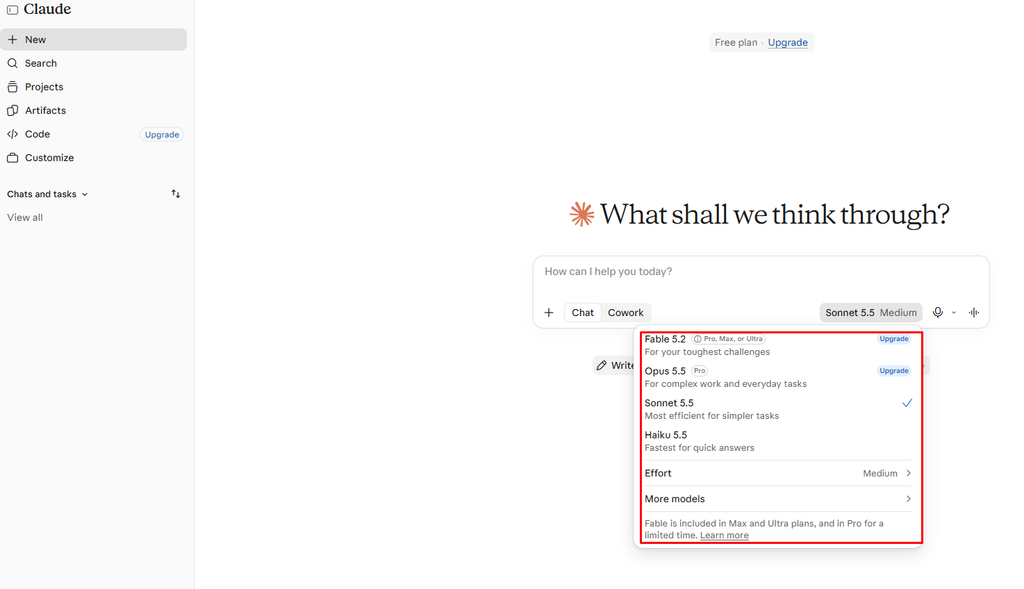
Looking at the screenshot, Claude’s model selector includes four main options: Fable 5.2, Opus 5.5, Sonnet 5.5, and Haiku 5.5. Each model comes with a short description that helps users understand its intended purpose. There are also additional controls for effort settings, more models, and subscription upgrades. Although the interface looks simple, it reveals an interesting approach to making AI more accessible to different types of users.
“Many models of it have now become available. On last 9th November, Fable 5.2 released a model, but this one is very easy and very important. I shared this one here.”
Fable 5.2: For Your Toughest Challenges
Fable 5.2 is the most prominent option in the screenshot. Claude describes it as a model designed for the toughest challenges, suggesting that it is intended for users who need additional capability for demanding tasks.
This positioning makes Fable 5.2 particularly interesting for people who regularly work with complicated prompts, detailed instructions, and tasks that require careful consideration. Rather than being presented as an ordinary everyday assistant, it is positioned as a more advanced option within Claude’s model lineup.
However, there is an important detail worth noticing: the screenshot displays an upgrade label next to Fable 5.2. This means access is not presented as a standard feature of the free plan. Users interested in trying this model may need an eligible subscription.
For someone who frequently works with challenging projects, having a dedicated option for demanding tasks can be useful. At the same time, not everyone necessarily needs to select the most advanced model for every conversation.
Opus 5.5: Designed for Complex Work
The next option is Opus 5.5, which Claude describes as being suitable for complex work and everyday tasks.
This description gives Opus a broader positioning than a model intended exclusively for the most difficult challenges. It appears to be aimed at users who want an option for substantial work while still handling regular activities.
For example, someone working on a detailed writing project, organizing information, or handling a multi-step task may find this category of model worth considering.
The screenshot also shows a Pro label and an upgrade option beside Opus 5.5. This indicates that access depends on the available subscription rather than being universally available to every user.
One advantage of this model-selection approach is that users can compare the available descriptions before deciding whether upgrading is worthwhile.
Sonnet 5.5: An Efficient Choice for Simpler Tasks
Sonnet 5.5 is the currently selected model in the screenshot, indicated by the blue checkmark.
Claude describes it as the most efficient option for simpler tasks. This is an important distinction because a powerful model is not always necessary for every request.
Many everyday activities do not require the most demanding AI capabilities. Writing short emails, asking general questions, summarizing simple information, and getting help with routine tasks are examples where users may prefer an efficient model.
Another interesting detail is that Sonnet 5.5 appears without an upgrade label in the displayed selection menu. The screenshot also shows the account operating on a Free plan.
This makes Sonnet particularly relevant to users who want to explore Claude without immediately committing to a higher subscription.
For everyday use, having an efficient model available directly from the selection menu makes the overall experience more practical.
Haiku 5.5: Built for Quick Answers
Haiku 5.5 is the final main model visible in the screenshot. Its description is short and clear: it is the fastest option for quick answers.
Speed can be an important consideration when using AI throughout the day. Not every question requires extensive reasoning or a lengthy response. Sometimes users simply want a quick explanation, a short answer, or assistance with a straightforward request.
This is where Haiku’s positioning makes sense.
By offering a separate option for quick interactions, Claude gives users another way to choose a model based on the nature of their work.
However, the screenshot does not provide actual response-time measurements or benchmark results. Therefore, it would be inaccurate to claim a specific speed advantage based only on this image.
Still, the distinction between demanding tasks, general work, simpler requests, and quick answers makes the model lineup easier to understand.
Benchmarks: How Fable 5.2 Compares
These are Anthropic’s own published numbers, so treat them as a strong signal rather than independent proof.
| Benchmark | Fable 5.2 | Fable 5.1 | Opus 5.5 | GPT-6 Astra | Gemini 4 Carbon |
|---|---|---|---|---|---|
| FrontierCode 2.0 (agentic coding) | 49.1% | 32.4% | 45.5% | 42.8% | 41.1% |
| FrontierSWE v2 (agentic coding) | 69.9% | 56.3% | 62.3% | 65.5% | 61.2% |
| OSWorld 2.1 (computer use) | 89.3% | 83.5% | 87.2% | 79.5% | 81.5% |
| Humanity’s Last Exam (with tools) | 74.2% | 65.6% | 67.7% | 57.2% | n/a |
| Chartography (chart reading) | 73.4% | 44.8% | 64.4% | 71.0% | 72.5% |
| AutomationBench (business workflows) | 51.4% | 31.4% | 42.5% | 41.4% | 53.9% |
What stands out:
- Fable 5.2 leads most coding and reasoning tests, with a big leap over 5.1.
- It isn’t best at everything. On AutomationBench, Gemini 4 Carbon scores higher.
- On chart reading, the gap with rivals is small.
- Compared with Opus 5.5, the gains are real but moderate on many tests, which is why Opus 5.5 remains Anthropic’s recommended daily driver.
Claude Fable 5.2 Pricing
API pricing
| Mode | Input (per 1M tokens) | Output (per 1M tokens) |
|---|---|---|
| Standard | $8 | $40 |
| Fast mode | $16 | $80 |
The API model name is claude-fable-5-2. It’s available on the Claude Platform, Amazon Web Services, Google Cloud, and Microsoft Azure.
Claude app plans
Fable models are included on eligible paid plans. For launch week, Anthropic says Pro plans and standard Team seats get Fable included for up to 50% of weekly usage limits, plus one to three usage resets depending on how long you’ve subscribed. Plan prices and limits change often, so check the official Claude pricing page before publishing this section.

Here I have shared a screenshot of the API pricing. You can get an idea by looking at the screenshot. And if you ever update it or take an updated plan, then definitely check the official website. Check it and then do it. The screenshot that I have given, I am giving it today, tomorrow it may get updated. That’s why you must check the official site, and after seeing it, purchase it.
Safety, Privacy, and Limits You Should Know
Cyber and biology blocks. Fable 5.2 blocks high-risk cybersecurity tasks (like penetration testing and exploit generation) and most research biology tasks. Blocked requests are automatically answered by an older model instead (Opus 4.8 for cyber, Opus 5 for biology). Security professionals can apply for Mythos 5.2 through Anthropic’s Cyber Verification Program.
Data retention. Fable 5.2 relies on monitoring to detect misuse, so Anthropic stores prompts and outputs for safety checks. Most customers get 30-day retention. Some enterprise customers can still use zero data retention for now. If you work with sensitive data, read the policy first.
Limited AI-research strength. Anthropic deliberately limited the model’s abilities in a few AI-development areas, such as kernel optimization, so it performs about at Opus 5.5 level there.
Frequently Asked Questions
Is Claude Fable 5.2 free?
Not fully. It’s included on eligible paid Claude plans and billed per token through the API. Check your own plan to see what’s available.
What’s the difference between Fable 5.2 and Mythos 5.2?
They’re the same underlying model. Mythos has fewer cyber and biology safeguards and is only for verified organizations.
Is Fable 5.2 better than Opus 5.5?
For complex, long-running technical work, yes, according to Anthropic’s benchmarks. For everyday use, Opus 5.5 is usually the more practical choice.
What is Fable 5.2’s API model name?claude-fable-5-2.
Does Fable 5.2 store my data?
Anthropic retains prompts and outputs for safety monitoring, generally for 30 days, with zero-retention exceptions for some eligible enterprise customers.
Final Verdict
Claude Fable 5.2 is a meaningful upgrade over Fable 5.1: faster, cheaper, and noticeably better at hard, multi-step technical work. If you build software, run agents, or do deep research, it’s worth trying. If you mostly want a smart everyday assistant, Opus 5.5 will likely serve you just as well for less.
Affiliate disclosure: This post contains affiliate links. If you click a link and make a purchase, we may earn a commission at no extra cost to you. We only recommend tools we have tested or believe are useful.